Chapter SF
relections on 2 weeks in Silicon Valley

A blog for myself and for friends who asked me about the trip
This is my attempt to capture everything I've seen and learned during my 2-week trip to SF. I was mainly there to attend a program called Silicon Valley Fellowship and Treehacks, but it ended up being much more than that.
Here are the highlights of the trip:
- Missed my flight and ended up meeting a wonderful Tunisian family who hosted me in their house
- Richard Socher ranch visit and talk
- Founders Inc last-minute visit
- Stanford visit and childhood friend reunion
Serendipity
You hear this word thrown around most of the time in SF, but you never really understand it until you stay there for some time.
You’ve probably heard that in order to increase your surface area for luck, you need to be in the right place at the right time. But what does SF have to do with this?
Let’s say you meet a random person in your hometown and you're tinkering with a few projects on the side. What are the probabilities that the person is in the tech field or investing in startups? Pretty low, if not zero. This is definitely not the case in SF. You can hear people passing through the park talking about valuations and potential board meetings, and that changes your whole perspective on how you're going to meet your next investor or the advice that you might receive from that person.
The beauty of the city is that you don't know who you're going to meet next. For instance, while I was attending an event hosted by a Google DeepMind engineer, I was discussing with the person sitting next to me how we were using AI coding agents at work to their full capacity. I ended up finding out that he attended MIT 12 years ago and was building a fintech startup that had just raised a Series A, which was extremely interesting. Another friend recounted to me how he found Michael Seibel randomly crossing the street (he didn't want to take a picture though). But that's not the point, this is just to show you that the probability of you meeting another interesting person is way higher than in any other place.
Speed
People move fast here. That's it.
The concentration of wealth and resources creates this highly curated network of people who have everything in their hands to make it work.
Your next-door neighbor is also building a startup and knows more about OpenClaw than you do. This lets people sell, raise, and find product-market fit faster than any other place on earth. Also, the sheer ambition of the individuals you're surrounded with makes you feel left behind if you're not keeping up with the speed. Most people would say that there’s some sort of performance benchmark where, if you're not building a YC startup or have raised some kind of big pre-seed or seed investment, you're just ngmi (as they say).
In some sort of way, there's a small micro-economy around AI. Founders sell to other founders. Investors throw money at those founders. Other founders go back and buy from the founders they sell to. Money keeps circulating in a tight loop until something sticks. But isn't that the whole point of building a company? Maybe the whole point is to keep shipping until you make it big enough to escape the bubble, or maybe it's to make something that people want. In the end, both of these converge into the same thing. This naturally leads to ask another big question.
What does it take to make it?
This is one of the questions I was expecting to get an answer to during this whole trip. After hearing many successful founders’ stories and how people emerged on their path toward success, this was the recurring question.
Especially as recent grads or college students, you always hear:
Should I do a PhD? Do I need to drop out of college or high school to start a company? Should I join a startup before starting one so I can learn from it or just jump in and learn from experience?
To simply answer it: just try something and stick to it.
But Skander, what are you talking about? Is this some misleading advice like “just keep pushing and you'll find a way,” and then buy my $999 course on how you can make money online?
No, that's not it.
In reality, success depends on a few core variables: the work you’re doing + the people you’re surrounded with + the place you live in. Some of these are within your control. Some are not. Timing, geography, and random encounters are dictated mostly by luck (barakah in Muslim terms).
But when you look at successful founders, there's no clear formula. Some have PhDs, others dropped out of university. Some will tell you to specialize in one thing from the start, others will tell you that you need to be a generalist. But one thing is common: the intensity in the work they pursued.
In very simple terms, stay persistent in the thing you're doing and work hard along the way while expecting nothing in return (at least for a year in 90% of cases).
Another thing to remember is adaptability (especially in the world of startups).
No one gets it right from the start, and if you don't want to listen to feedback from people around you, you've basically lost from the start. It's important to step back if nothing is working and be prepared to start from zero (multiple times), pivot when there's no clear direction, and let go of ego when it's necessary, even if that means letting go of something you spent months building because the world shifted. Especially now, with the AI wave moving so fast, nothing is really clear. The people who are on top of the game are the ones willing to explore and experiment rather than just chase short-term results.
Staying in the game long enough and increasing your surface area for luck, those are the important factors.
You can just do things
But I'm not in SF anymore, or I’ve never been. What can I do? Should I just wait until I get there to start working?
Short answer: no.
Long answer: nooooooooo. (joke)
Long answer is: nooooooooo, just keep shipping.
In a world where the AI race is real, the only real thing left to assess an individual is agency. This is why it's important to make progress your own way. Take on as many challenges as you can when you're studying at university or at work. Be adaptable so that when the right opportunity comes along, you are ready. Get out of your comfort zone whenever you have the chance, as sitting at a desk coding is not really showing a great signal.
I know this might be a little offsetting, as I still have no concrete proof of work.
And one other thing is to post more or let proof of your work exist on the internet. This is advice that I am giving to myself too. Opportunities are getting scarcer by the day, and applying to a job or launching a product is getting noisier, so you need to stand out from the crowd. No amount of complaining about the job market will actually lead you to your next offer. You just own it and find a way.
Also, one other important thing: lead with value. This is also on my to-do list. What I exactly mean is that instead of asking people to hire you for a job directly, stand out and try to provide first with nothing in return. This might also help you, as people will see that you are helpful and you're good at what you're doing. Also, a lot of people will respect you if you're already hustling and trying, even if you don't have many resources (third-world country problems). Effort still signals you're moving forward, and people respect that. The sooner you understand that no one owes you anything in this life, the better you will be at creating yours.
Ending?
In the end, SF isn't a place with zero flaws or utter perfection as they make you believe it.
It's hella expensive (no, I don't want to eat a $15 burger), walking in the street can be a horrendous experience (Tenderloin), and the political climate isn't the best.
But the real charm, apart from the weather, is the people. And that's when I understood what SF really has to offer. It's the land of immigrants who dream big, and everyone around you has dropped everything and is working all day to the point where that becomes the norm. It is, in fact, founders' natural habitat.
Thank you for taking the time to read this. I hope this covers everything and clarifies a few things about SF for people wondering, here are some Gifs for sticking to the end!
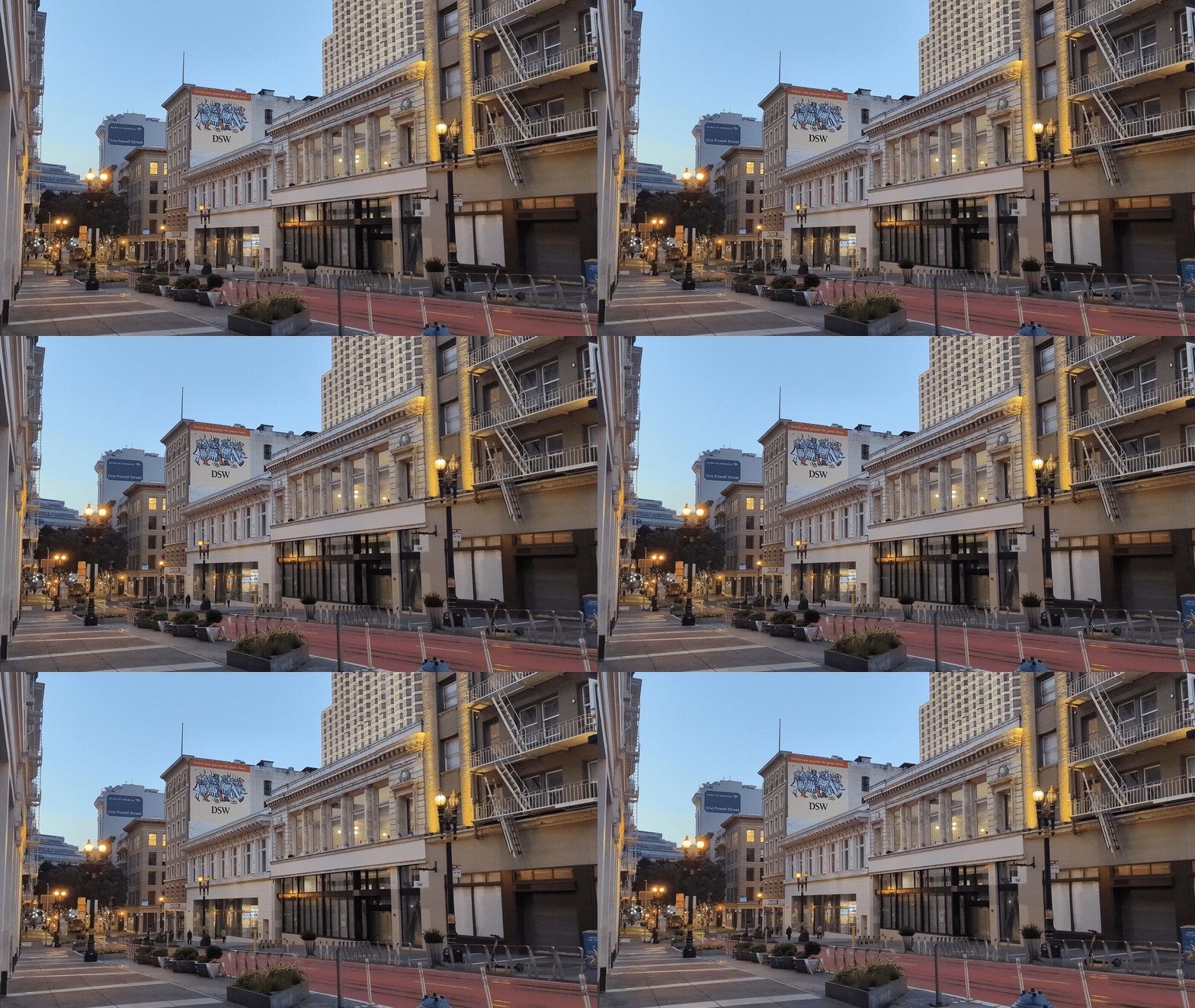
Typical street in SF

Oakland Bay Bridge scenery
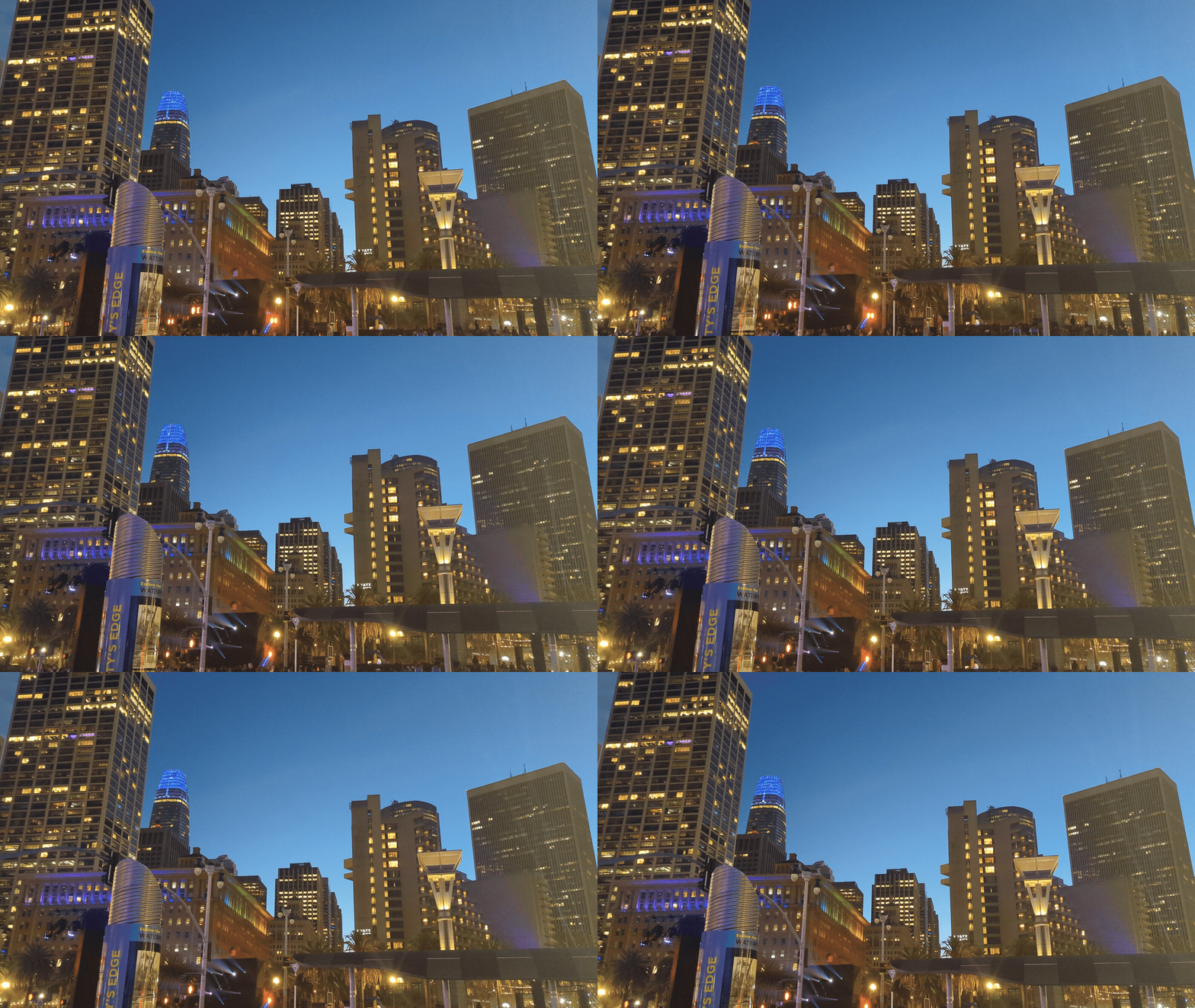
SF by night
I’m trying to write more. If you’d like to get an email whenever I publish something, drop your email below.